Specialist lighting engineering, delivered as a dedicated discipline
01
Roadway & Street Lighting Design
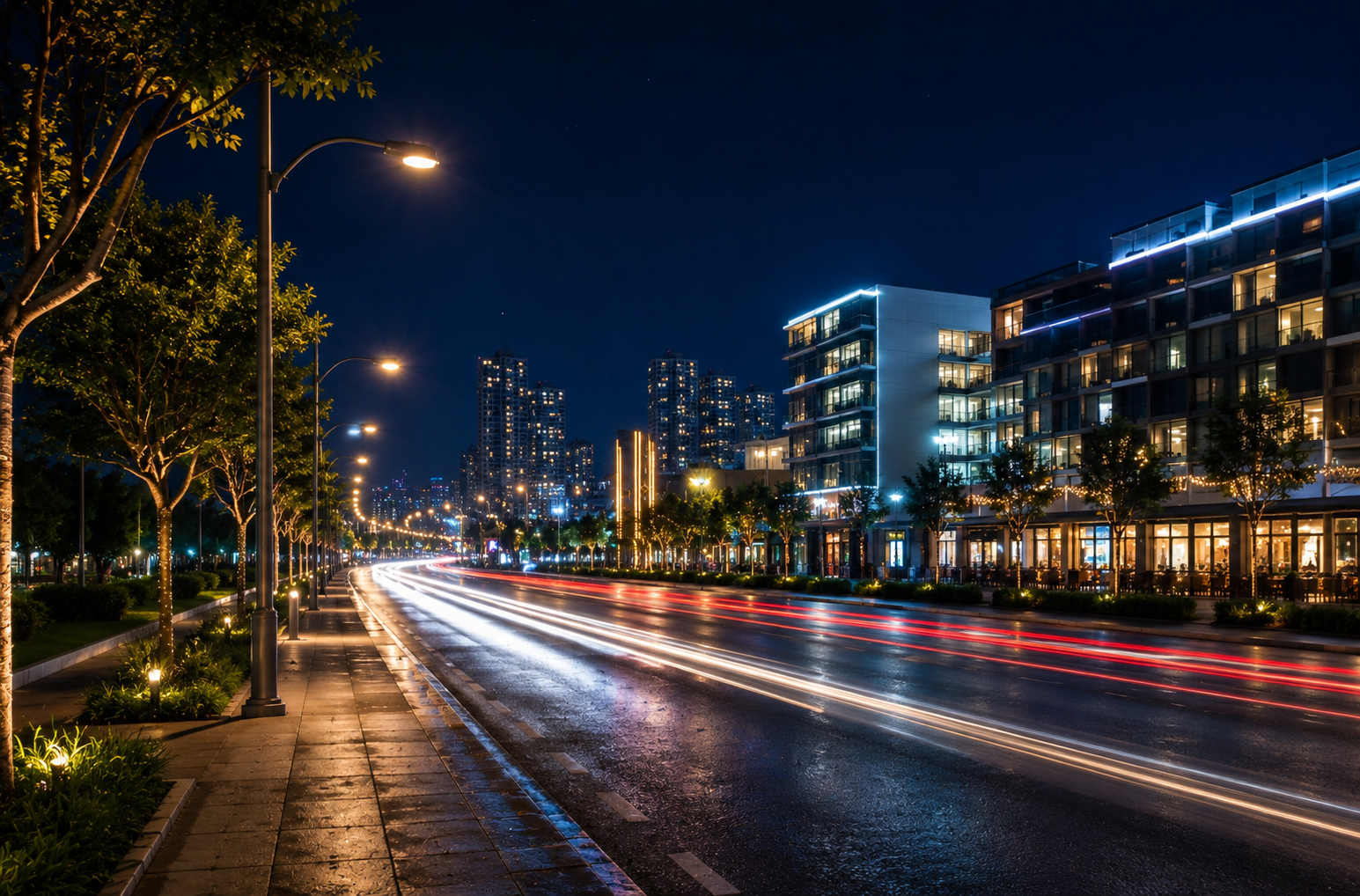
Photometric design for arterials, collectors, and local streets, balancing pole spacing, luminance uniformity, and glare control to meet agency and safety standards at the lowest energy draw the code allows.
Photometric analysis of survey and inspection data from existing installations, identifying under-lit, over-lit, and glare-prone conditions, resolved through mitigation designs built to close safety and compliance gaps.
Conflict-zone photometrics for signalized and unsignalized intersections, engineered to raise driver and pedestrian detection at points of vehicle conflict without introducing disability glare.
Circulatory and approach-arm lighting calibrated to guide driver expectation through roundabout geometry, with uniformity ratios tuned for confident night-time wayfinding.
Threshold, transition, interior, and exit-zone lighting calculated against adaptation-luminance curves, preserving visual continuity for drivers entering and leaving the bore.
Structural, navigational, and roadway lighting for bridges and overpasses, coordinating illuminance levels with structural clearances, maintenance access, and marine navigation requirements where applicable.
Shared-use trail and greenway lighting engineered for pedestrian and cyclist visibility, with dark-sky sensitivity calibrated for adjacent parks, waterways, and residential edges.
Surface lot and structured-garage lighting engineered for uniform coverage and CPTED-aligned visibility, with control-credit strategies that reduce operating cost without compromising security.
LED conversion and controls upgrades for aging roadway, garage, and site lighting, sequenced to minimize operational disruption while maximizing energy and maintenance savings.
Independent luminaire specification and procurement guidance for the main consultant, paired with aiming diagrams, focus criteria, and performance benchmarks that let the installer verify delivered results against the design model.
Photometric simulation and BIM-coordinated lighting documentation, delivering validated renders, false-color luminance studies, and clash-free families that carry through coordination and tender.
Obtrusive-light modeling and mitigation design for sensitive sites, observatories, and protected landscapes, controlling upward light ratio, spill, and glare to meet dark-sky and environmental-zone requirements.